What Is Resilience and How to Build It in Everyday Life?

Life rarely follows a perfectly predictable path. Unexpected changes, professional setbacks, family pressures, financial concerns, and personal disappointments can affect anyone. In this artocle of success at top we say more about it.
While people cannot control every difficult situation, they can improve how they respond to it. This ability is known as resilience.
Resilience is often misunderstood as an inborn quality possessed only by exceptionally strong people. In reality, it is a collection of thoughts, behaviors, emotional skills, and supportive habits that can be learned over time. Building resilience does not remove stress or guarantee that life will always feel manageable. Instead, it helps people adapt, recover, and continue moving forward with greater awareness and confidence.
Understanding resilience as a skill makes it practical. It becomes something that can be strengthened through everyday decisions rather than an abstract form of mental toughness.
What Is Resilience?
Resilience is the capacity to cope with adversity, adapt to change, and recover after stressful or challenging experiences. It allows a person to remain psychologically flexible when circumstances become difficult.
A resilient person still experiences sadness, fear, anger, frustration, and uncertainty. Resilience does not require anyone to suppress emotions or pretend that a problem is insignificant. It involves recognizing those emotions, understanding what they communicate, and choosing a constructive response.
For example, losing an important opportunity may initially cause disappointment. A resilient response does not deny that disappointment. It creates room to process the experience, identify useful lessons, seek support, and decide what to do next.
This distinction matters because resilience is not emotional invulnerability. It is the ability to recover and adapt without losing contact with reality.
Why Is Resilience Important in Everyday Life?
Resilience supports emotional well-being in both major crises and ordinary situations. Daily life includes missed deadlines, disagreements, sudden expenses, demanding responsibilities, and plans that change without warning. When these pressures accumulate, they can reduce concentration, patience, and motivation.
Building resilience can help people:
- Manage stress more effectively
- Recover from mistakes and setbacks
- Make clearer decisions under pressure
- Maintain healthier relationships
- Adjust to unexpected changes
- Protect their sense of purpose
- Develop greater confidence in their coping abilities
- Support long-term personal growth
Resilience can also influence how someone interprets a difficult experience. Instead of viewing one setback as proof of permanent failure, a resilient person is more likely to see it as a specific event that requires reflection, adjustment, or patience.
That perspective does not make challenges disappear, but it can prevent temporary difficulties from defining a person’s entire identity.
Is Resilience the Same as Mental Toughness?
Resilience and mental toughness are related, but they are not identical. Mental toughness usually refers to persistence, focus, and the ability to perform under pressure. Resilience has a broader meaning that includes emotional recovery, flexibility, self-awareness, and the willingness to seek help.
Mental toughness may help someone continue working toward a demanding goal. Resilience also helps that person recognize when the original plan needs to change, when rest is necessary, or when support would improve the outcome.
Healthy resilience is flexible. It balances persistence with adaptation and independence with connection. Continuing at any cost is not always a sign of strength; sometimes the stronger response is to pause, reassess, and select a more sustainable direction.
What Factors Help Build Resilience?
Resilience develops through several connected factors. No single habit creates it on its own, and different people may rely on different combinations of internal and external resources.
Self-Awareness
Self-awareness helps people recognize their emotions, thoughts, physical reactions, and behavioral patterns. When someone can identify that they are becoming overwhelmed, they have a better chance of responding before stress controls their behavior.
A simple emotional check-in can help. Asking, “What am I feeling, what caused it, and what do I need right now?” turns a vague sense of distress into information that can guide action.
Supportive Relationships
Strong relationships are among the most important foundations of resilience. Trusted friends, relatives, colleagues, mentors, or mental health professionals can provide emotional support, practical assistance, and a more balanced perspective.
Seeking support is not evidence of weakness. It is a practical coping strategy that reduces isolation and expands the resources available during a difficult period.
Flexible Thinking
Flexible thinking means considering more than one interpretation or solution. Under stress, people may fall into rigid patterns such as “This always happens,” “I cannot handle this,” or “Everything is ruined.” These thoughts can make a specific problem feel permanent and universal.
A more flexible approach asks questions such as:
- What facts support my current interpretation?
- Is there another way to understand the situation?
- Which part of this problem can I influence?
- What would I advise a friend to do?
These questions do not promote unrealistic optimism. They create a more accurate foundation for solving problems.
A Sense of Purpose
Purpose gives difficulty a wider context. It may come from family, meaningful work, creativity, service, learning, faith, or a personal value. A clear sense of purpose helps people remember why continued effort matters, especially when immediate circumstances feel discouraging.
Purpose does not need to be grand. A small commitment, such as caring for a family member or developing a useful skill, can provide direction and stability.
How to Build Resilience in Everyday Life
Building resilience is most effective when it becomes part of ordinary life. Waiting for a crisis to develop coping skills makes the process harder. The following practices can strengthen resilience gradually and sustainably.
1. Focus on What You Can Control
Stress often increases when attention remains fixed on circumstances outside personal control. Divide the situation into three categories: what you can control, what you can influence, and what you must currently accept.
You may not control another person’s decision, but you can control how clearly you communicate. You may not control an economic change, but you can review your spending, update your skills, or request professional guidance. Directing energy toward actionable areas restores a sense of agency.
2. Break Challenges into Smaller Steps
Large problems can feel overwhelming when treated as a single task. Break the challenge into specific, manageable actions and identify the smallest useful next step.
If you are facing professional uncertainty, the first step might be updating one section of your resume. If your home feels disorganized, begin with one drawer or one surface. Progress becomes easier when the next action is concrete.
3. Develop a Realistic Inner Voice
Self-talk affects emotional recovery. Harsh statements such as “I fail at everything” turn one experience into a judgment about personal worth. A realistic response might be, “This did not work as expected, and I need to understand why.”
Constructive self-talk should acknowledge the difficulty while preserving the possibility of action. This approach supports both resilience and personal growth because it encourages responsibility without unnecessary self-punishment.
4. Protect Basic Physical Needs
Sleep, movement, hydration, and balanced nutrition affect the nervous system and the ability to regulate emotions. When basic physical needs are ignored, ordinary challenges can feel more intense.
A resilient routine does not require an extreme wellness program. Consistent sleep times, regular meals, short walks, and brief periods away from screens can improve energy and mental clarity. Physical care provides a stronger base for emotional coping.
5. Practice Emotional Regulation
Emotional regulation means responding to feelings without being controlled by them. Useful techniques include slow breathing, journaling, mindfulness, exercise, and naming an emotion aloud.
One simple method is to inhale slowly, exhale for slightly longer, and repeat the cycle for one or two minutes. A longer exhalation can help calm physiological arousal, creating enough space to choose a thoughtful response.
6. Learn from Setbacks Without Living in Them
Reflection can transform a setback into useful information. After a difficult event, ask what happened, what was within your control, what you learned, and what you would change next time.
Reflection becomes unhelpful when it turns into endless rumination. The goal is to extract a lesson and apply it, not to replay the event repeatedly. Setting a time limit for reflection can keep the process constructive.
7. Strengthen Your Support Network
Do not wait for an emergency to build meaningful connections. Regularly contact people you trust, participate in communities that share your interests, and offer support to others when possible.
Resilient relationships are reciprocal. They create a sense of belonging and make it easier to ask for help when circumstances become difficult.
8. Accept Change as Part of Life
Change can involve loss, uncertainty, and discomfort. Acceptance does not mean approving of every situation. It means recognizing what is currently true so that energy can move from resistance toward adaptation.
When plans change, identify what remains stable, what needs revision, and which new opportunities may become available. Adaptability is one of the clearest expressions of resilience.
9. Set Healthy Boundaries
Constant availability can weaken emotional and physical resources. Healthy boundaries define what you can reasonably give, what behavior you will accept, and when you need time to recover.
Clear boundaries support resilience because they reduce preventable stress. A respectful “I cannot take that on this week” can protect the capacity required for existing responsibilities.
10. Recognize Progress
People often notice what remains unfinished while overlooking how far they have come. Recording small achievements provides evidence that effort is producing movement.
At the end of each week, write down one challenge you handled, one lesson you learned, and one action you completed. This practice develops confidence based on real experience rather than empty reassurance.
Common Myths About Resilience
Several misconceptions can interfere with building resilience.
Myth 1: Resilient people never struggle. Resilient people experience pain and uncertainty, but they develop ways to process and respond to them.
Myth 2: Resilience means handling everything alone. Social support is a central part of healthy resilience, and asking for help can be an effective decision.
Myth 3: Positive thinking solves every problem. Resilience depends on realistic thinking, practical action, and emotional honesty rather than forced positivity.
Myth 4: People are either resilient or they are not. Resilience can change across situations and stages of life. Skills, resources, health, and support all influence it.
Myth 5: Moving forward means forgetting what happened. Recovery may include remembering, grieving, learning, and gradually creating a new sense of stability.
When Professional Support May Help
Self-help strategies are valuable, but they are not a replacement for professional care when distress becomes persistent or severe. Consider speaking with a qualified mental health professional if stress significantly disrupts sleep, work, relationships, daily responsibilities, or personal safety.
Therapy can help people understand patterns, process traumatic experiences, develop coping skills, and create a structured recovery plan. Professional support is especially important when someone experiences prolonged hopelessness, panic, substance misuse, or thoughts of self-harm. In an immediate safety crisis, contact local emergency services or an appropriate crisis service without delay.

Frequently Asked Questions About Resilience
1. Can resilience be learned at any age?
Yes. Resilience can be developed throughout life. Children, teenagers, and adults can all strengthen it through supportive relationships, emotional awareness, problem-solving skills, healthy routines, and repeated practice.
2. How long does it take to build resilience?
There is no universal timeline. Resilience develops gradually through daily habits and real experiences. Some coping skills may help immediately, while deeper patterns of confidence and adaptability usually strengthen over months or years.
3. Does resilience mean staying positive all the time?
No. Healthy resilience includes acknowledging fear, sadness, anger, and disappointment. The objective is to process emotions honestly and respond constructively, rather than maintaining constant positivity.
4. What is the best daily habit for building resilience?
A short daily check-in is a useful starting point. Identify what you feel, what you can control, and the next helpful action. Combining this practice with adequate sleep, movement, and social connection produces a stronger foundation.
5. How are resilience and personal growth connected?
Resilience helps people learn from challenges, adapt their behavior, and develop confidence in their ability to cope. Personal growth often emerges when difficult experiences are processed thoughtfully and converted into practical lessons.
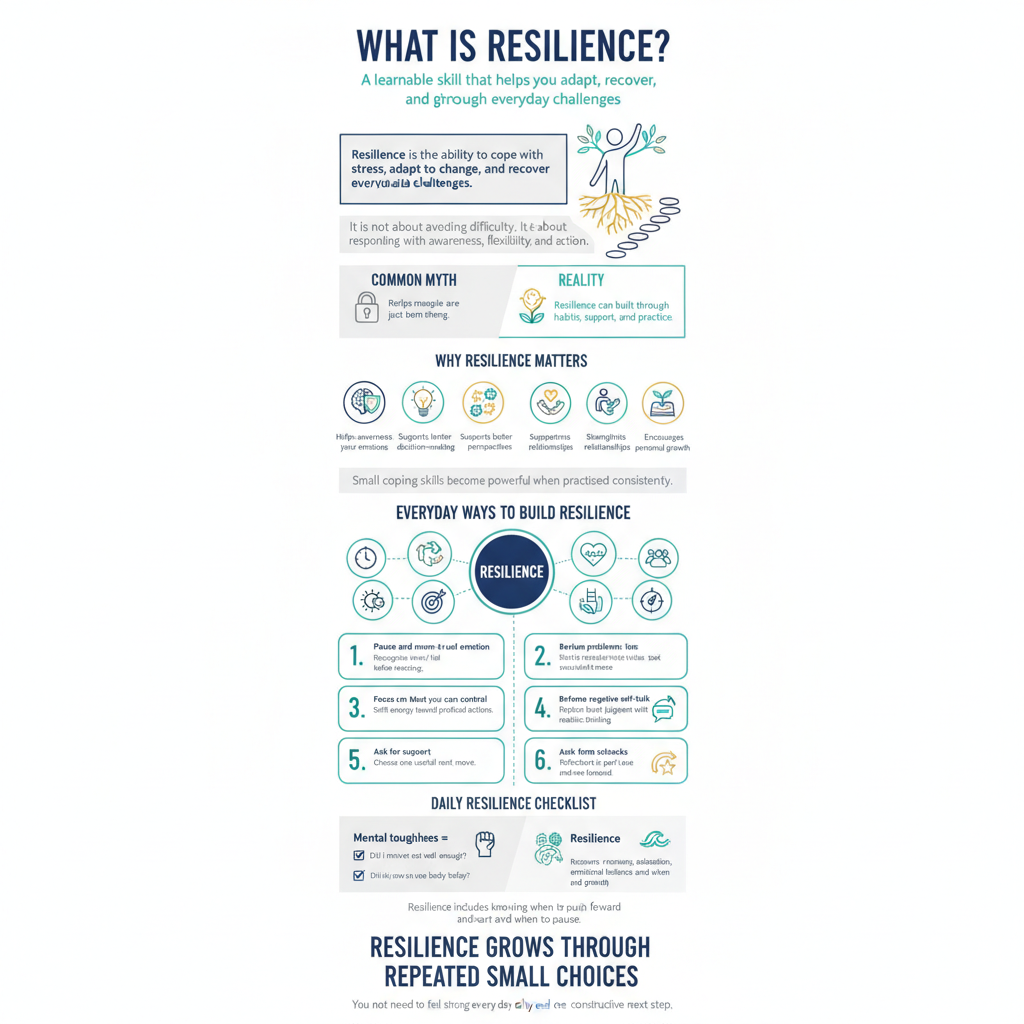
Infographic : What Is Resilience?
Conclusion
Resilience is not a fixed personality trait reserved for unusually strong people. It is a practical and learnable capacity built through self-awareness, flexible thinking, supportive relationships, healthy routines, emotional regulation, and purposeful action.
Building resilience does not require dramatic transformation. It begins with small choices: taking one manageable step, asking for support, protecting basic needs, reviewing a setback honestly, or focusing attention on what can be influenced today. Repeated consistently, these choices improve the ability to adapt and recover.
Life will continue to contain uncertainty, but resilience helps people meet that uncertainty with greater clarity, flexibility, and confidence. The goal is not to avoid every difficulty. It is to develop the skills and support needed to move through difficult experiences while continuing to grow.